Lipce village inn
The PeasantsLipce village inn is both a drinking place and one of Lipce’s principal settings for everyday sociability. At the village’s edge, beyond the presbytery and at the head of the poplar road, it gathers farmers, women, and passers-by for music and conversation. The inn’s importance rests not simply on what people drink but on their desire to meet neighbours, exchange complaints, and hear what is new; when it is closed, the village’s shared rhythms give way to a more solemn quiet.
Setting and atmosphere
The inn stands at the end of the village, beyond the presbytery, where the poplar road begins. Its great chamber has a smoky black ceiling, small scorched panes, and a floor worn by many feet. In the early evening, the setting sun sends only a faint streak across the floor while gloom gathers in the corners. The room is not always busy: at one visit, it is nearly empty, and the music starts only now and then. Young people linger or romp outside in the orchard and driveway, while girls and women sit on freshly cut yellow timber near the walls.
Sound gives the room its own character. The bass viol hums, the fiddle answers with a high squeal, and the tabour rattles; as more people arrive, music and conversation fill the chamber. The inn’s atmosphere shifts with the hour and the weather, from an early, shadowed quiet to a crowded, noisy Sunday gathering.
Kuba and Jankiel at the bar
Kuba goes straight to the bar, where Jankiel sits in his shirtsleeves and yarmulke, stroking his grey beard as he reads with his eyes close to the page. Kuba hesitates, shifting his weight and counting his money. Jankiel waits without interrupting his swaying and prayer, occasionally clinking glasses, until Kuba finally orders a strong pint.
The encounter makes the inn a place where small sums matter. Kuba has spent his money and owes Jankiel, yet remains at the bar rather than leaving; Jankiel pours him another drink, now arak, and says nothing. The exchange shows their contact taking place through an informal debt as well as through the sale of drink. At the inn, a customer’s limited means do not immediately end his stay, even as the unpaid account follows him into the evening.
A Sunday meeting place
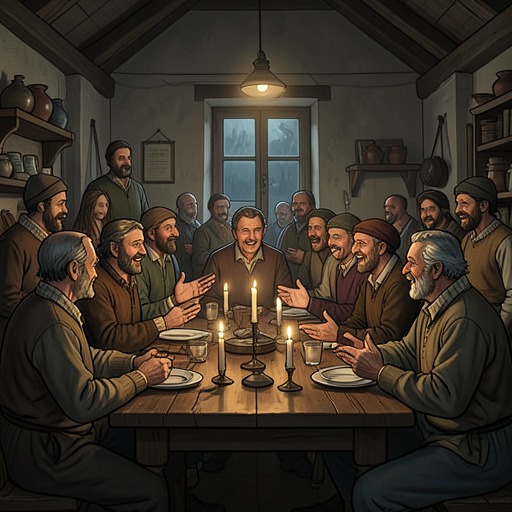
As dusk deepens, more villagers arrive. Some gather at the bar, others sit against the walls or stand in the middle of the room, debating, chatting, complaining, and occasionally toasting one another. The narration emphasizes that they have not come chiefly to drink: they want to mingle with neighbours, listen to the fiddle and bass viol, and hear something new. Sunday rest makes the visit acceptable, provided people behave decently and do not offend God.
The crowded inn thus turns individual leisure into a communal practice. Older farmers take seats at the tables, and women in red woollen skirts and shawls join the gathering. With everyone speaking at once, the room hums like a forest; feet tap against the floor as the music carries the crowd into a livelier mood. Its social life is made of ordinary talk and listening as much as of music, and its noise reflects a village accustomed to sharing news and company in public.
Errands, weather, and closure
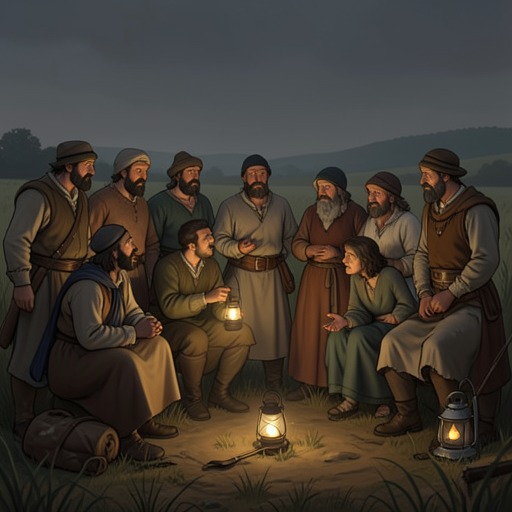
The inn also serves as a brief stopping point in the village’s practical routines. Before setting out together, Maciej Boryna and his companions go there for a quick glass and arak to take along. Maciej urges them not to linger: the visit is a pause within an errand, not the evening’s destination. On another occasion, Dominikowa’s sons obey her instructions to tend the cows and mash potatoes for the pigs before they go to the inn. Their departure takes place in autumn darkness and blustering weather; wind shakes the treetops, the pond splashes foam onto the road, and a broken window lets the gusts into the inn, swinging the lamp behind the bar.
The inn’s social role has a boundary. On the night when villagers gather to pray for the dead, the village is quiet despite the holiday, the roads are empty, and the inn is closed. A few lights show through cottage windows; the sounds that remain are pious singing and prayers. The contrast does not make the inn an enemy of religious life: it shows that communal gathering takes different forms according to the occasion. On an ordinary Sunday, music, drink, and conversation bring neighbours together; in remembrance of the dead, that shared life withdraws into prayer and silence.